Read
Look beneath the visible problem. Identify the contribution required, the people and pressures involved, and the condition that is limiting progress.
Leadership that multiplies what others can contribute.
The Missing Intelligence?
Read→Shift→Enable→Multiply
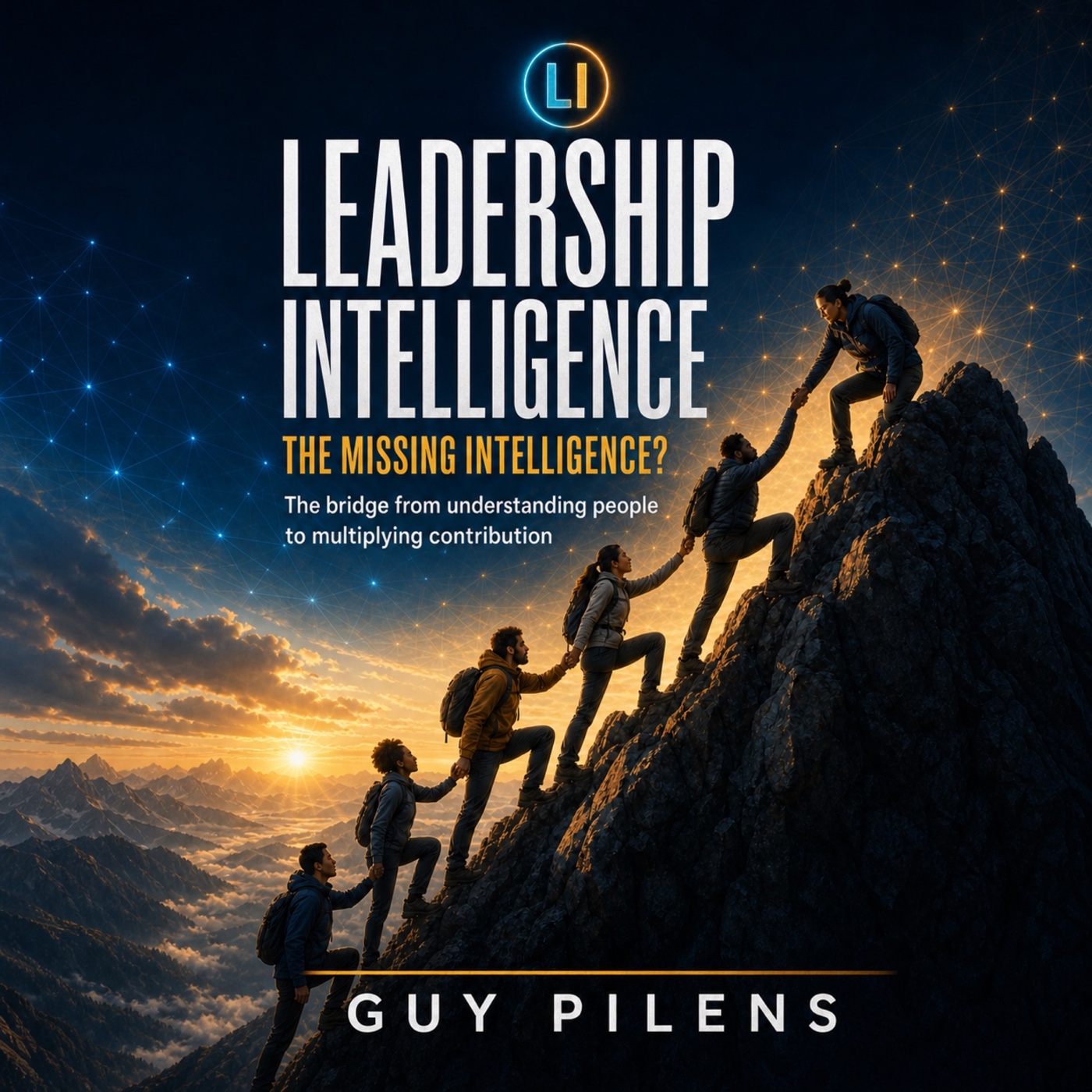
How well do other people contribute because of your leadership?
IQ, emotional intelligence, social intelligence and artificial intelligence can expand what a leader understands or can personally do. Leadership Intelligence asks what the leader does with that capability in context.
A response is intelligent only when it fits the contribution required. Sometimes leadership means directing, deciding or protecting. At other times it means questioning, coaching, transferring authority, repairing trust, removing a system constraint or stepping back.
The test is not whether the leader appeared capable. The test is whether people, teams and systems became better able to think, decide, act, learn and continue.
The LI cycle turns a broad leadership idea into four disciplined moves that can be used in the next decision, conversation, meeting or system challenge.
Look beneath the visible problem. Identify the contribution required, the people and pressures involved, and the condition that is limiting progress.
Interrupt the leadership habit that would place you at the centre. Choose the response the situation needs—not simply the response that made you successful before.
Strengthen clarity, responsibility, authority, flow, trust, capability and follow-through so that others can carry meaningful contribution safely.
Turn useful learning into shared judgement, stronger routines and wider capability. Ask what will work better next time—even when you are absent.
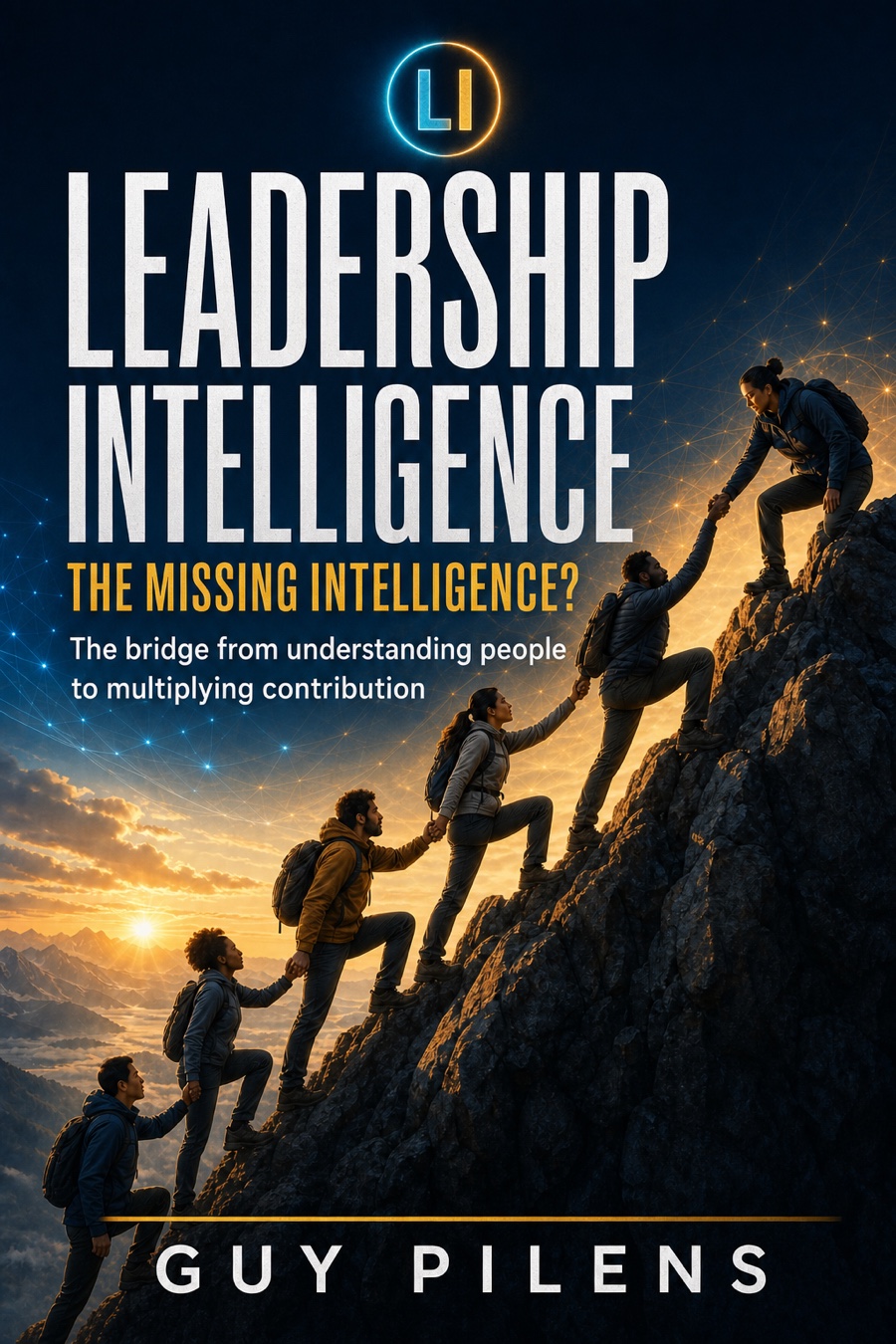
The Missing Intelligence?
The book is written for capable contributors, technical experts, managers, project and program leaders, and experienced leaders who suspect that their dependability may have made them too central.
It connects personal leadership behaviour with trust, judgement, team contribution, organisational maturity, succession and the systems that allow contribution to continue.

Twenty-Six Propositions for Leadership, Organisational Maturity and Contribution Through Others
A practical companion for leaders, facilitators, coaches and teams who want to turn Leadership Intelligence into meaningful conversation and observable change.
The book contains 26 stand-alone discussion papers covering expert-to-enabler leadership, delegated judgement, trust, authority, capability, change, boundaries, AI and multiplying contribution through others.
Start with the Leadership Intelligence (LI) App to explore leadership choices and their effects. Then progress to LI Mentor Lab for deeper reflection, evidence-led thinking and contextual judgement.
 Step 1 · Start here
Start with a simpler question-and-answer game. Choose a leadership response and see its effect on contribution conditions and simulated CMMO® maturity. The full iPhone/iPad app contains 500 scenarios.
Website demo: 10 questions from a pool of 20.
 Step 2 · Go deeper
After practising with the LI App, move into deeper thinking with LI Mentor Lab. Investigate evidence, weigh the context, explain your reasoning and reconsider when circumstances change across 150 workplace scenarios.
See what your leadership decisions make possible for others.
Explore 500 original scenarios in the full iPhone and iPad app. Choose a response, see its effects on contribution conditions and simulated CMMO® organisational maturity, and connect the learning with Read, Shift, Enable and Multiply.
Try the website demo: 10 questions per game from a limited pool of 20. A second game uses the remaining questions, so you can explore different situations without repeats.
Available now on the App Store for iPhone and iPad.
Scenario effects are illustrative learning assumptions, not a validated assessment of an organisation.
Practise leadership judgement where the consequences unfold over time.
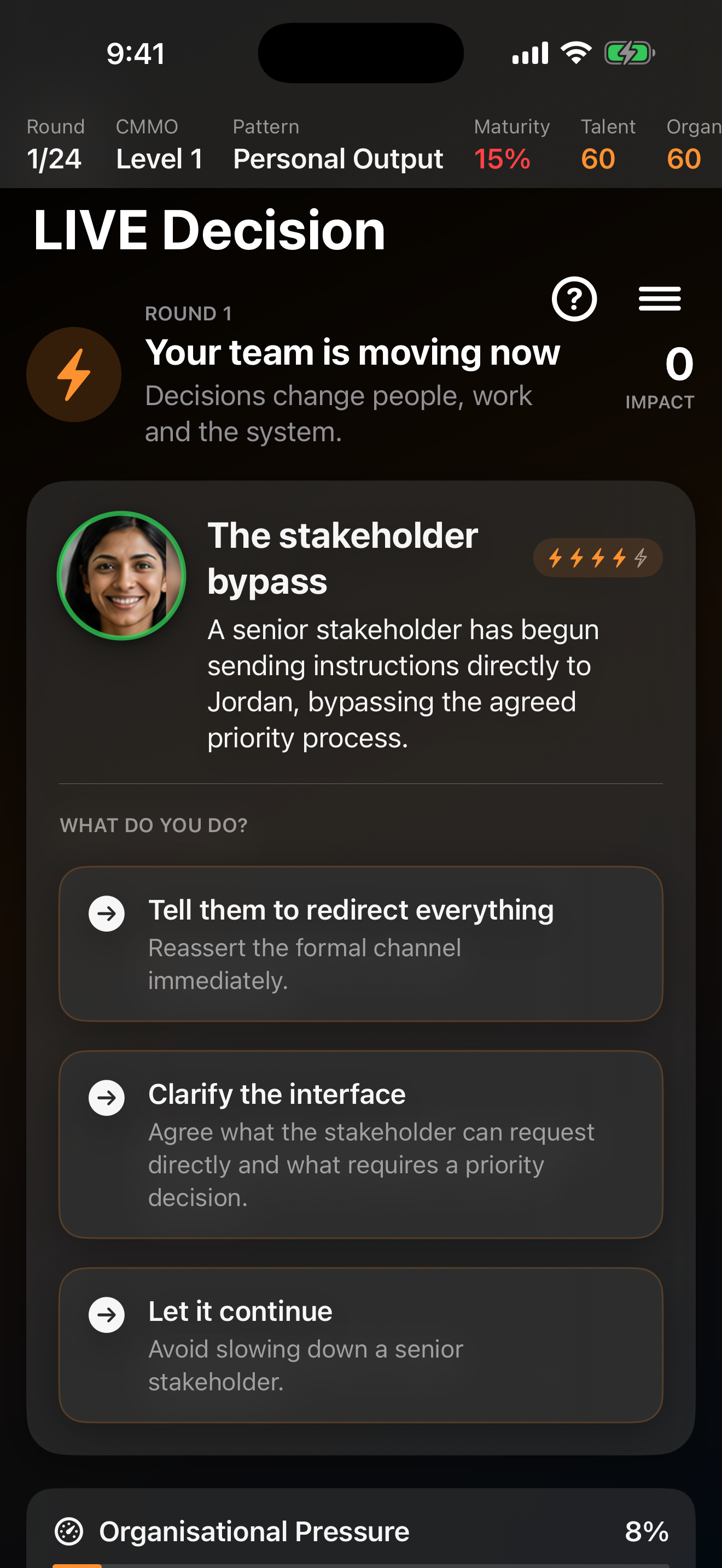
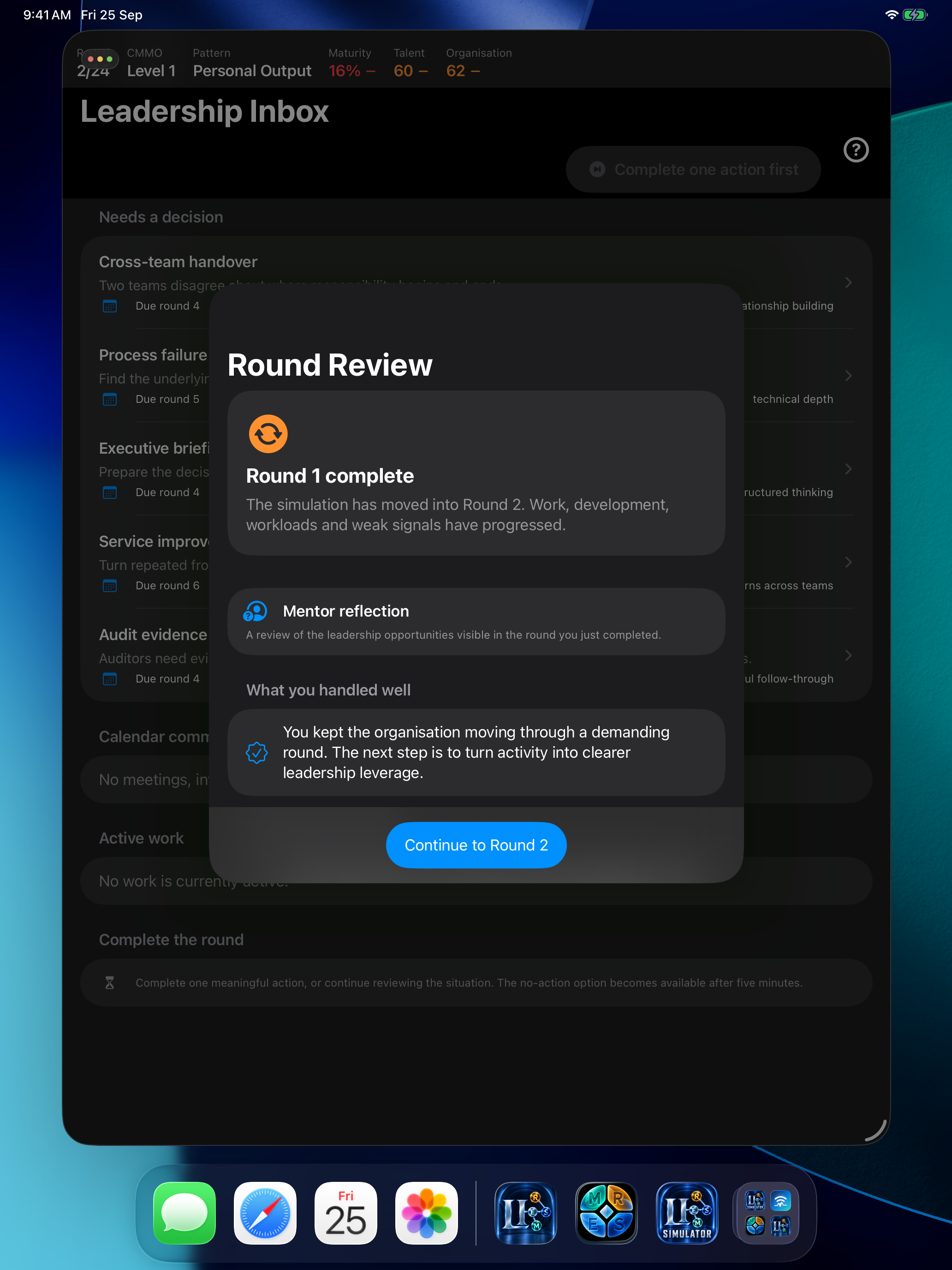
The Leadership Intelligence Simulator turns Read, Shift, Enable and Multiply into a living decision environment. Work through more than 200 leadership scenarios, make LIVE decisions, complete rounds and see how your choices affect trust, capability, workload, pressure and contribution.
Now available on the App Store. Download the simulator for iPhone and iPad to practise solo or run facilitated group sessions.

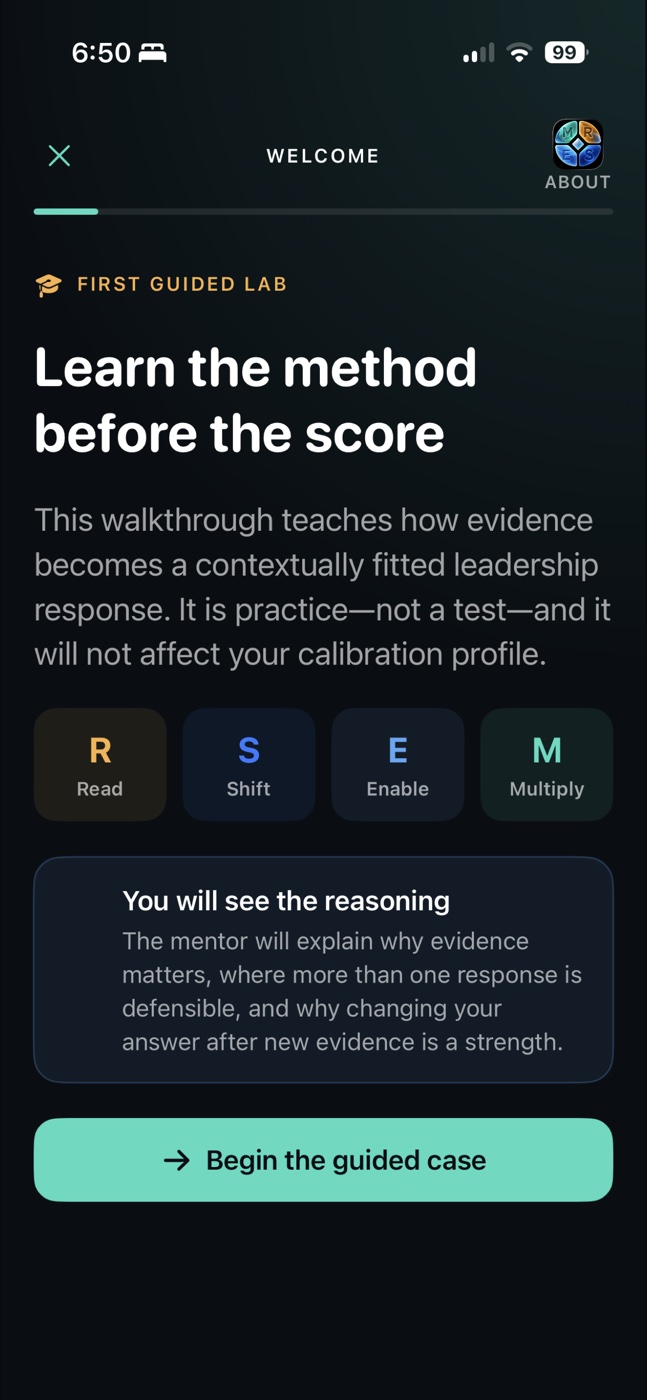
The book and audiobook explain the framework. LI Mentor Lab turns it into deliberate, scenario-based practice. Across 150 workplace situations, you investigate limited evidence, interpret what is governing the situation and choose how to Read, Shift, Enable and Multiply.
Examine the person, task, relationship, risk, time and system before acting on your first explanation.
Practise when to direct, decide, question, coach, connect, protect, delegate or step away—according to context, not habit.
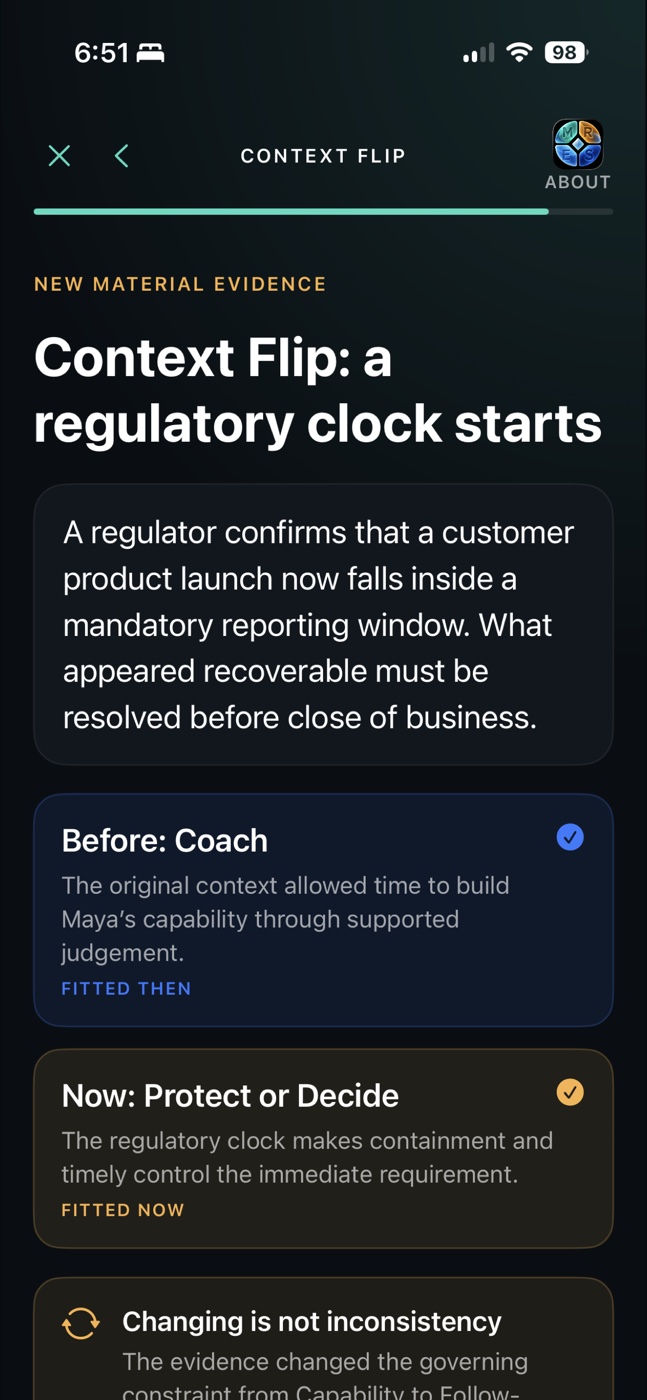
A Context Flip introduces material new evidence and asks whether your original response still fits.
Debriefs, shared-device Team Leadership Huddles and Workplace Experiments turn scenario insight into action.
Choose Guided, Reflective or Independent mentor support as your judgement develops. Solo Calibration helps make recurring patterns visible, while Workplace Experiments create a small, observable bridge into real leadership work.
What it develops: evidence-led contextual judgement—not answer memorisation, a personality score, psychometric assessment or certification.
The unabridged audiobook carries the complete contribution-based framework into a format designed for reflection while travelling, walking or preparing for real leadership work.
Listen to a sample from the Prologue: The Climb
Prologue — The Climb
From a distance, leadership can look like reaching the summit. We notice the person at the top. We see the title, the authority, the larger decisions and the wider view.
The language of leadership encourages this picture. People rise through organisations. They climb the ladder. They reach senior positions. They become the person others look towards.
But that is not the most important part of the climb.
The real leadership moment occurs when the person above turns around, reaches back and helps another person find their footing. It occurs again when that person becomes steady enough to reach for someone else. The climb stops being an individual achievement and becomes a chain of contribution.
No one in that chain is passive. Each person must still carry their own weight, choose the next foothold and make the effort. Yet no one must pretend that independence means isolation.
Strength moves in both directions. A hand reaches upward for support and downward to provide it. Information passes along the line. Confidence travels. Judgement grows. Progress becomes possible because contribution is connected.
That is the central image of this book.
Leadership is not arriving first. It is increasing the number of people capable of making the climb.
This sounds simple until pressure arrives.
Under pressure, capable people often return to the behaviour that first proved their value. They take over. They solve. They rescue. They carry. They move quickly because they can see the answer and fear what may happen if they wait.
Their effort can be impressive. It can also leave everyone below them waiting for the next instruction or the next rescue. The leader reaches the difficult ground, but the team does not learn how to cross it.
Leadership Intelligence begins at precisely this point.
It is the intelligence required to recognise what contribution a situation needs, to shift your own contribution accordingly, and to create the conditions in which other people can think, decide, act, learn and grow.
It is not leadership as image. It is not charisma, confidence or a collection of techniques. It is not the ability to remain the smartest or strongest person in the line.
It is the practical capacity to convert personal capability into contribution through others.
Australian listening options and selected international catalogue links are listed below. Prices, availability and subscription access vary by service and account location.
OverDrive lists the audiobook for library acquisition; availability in Libby depends on whether an individual library has licensed it. Chirp carries a catalogue listing but does not currently offer the title in Australia.
View the complete three-audiobook international distribution directory.
The unabridged audiobook is distributed internationally through the storefronts and services below. Select your country or preferred service. Prices, subscription access and review features are controlled by each retailer and may vary by location.
Author: Guy Pilens · Narrator: AI Voice Guy Pilens · ISBN 9798182612678
Each link opens the Leadership Intelligence audiobook listing for that retailer or catalogue. On a smaller screen, swipe sideways to see the full table.
| Retailer or catalogue | Markets covered | Book listing links | Public review position |
|---|---|---|---|
| Audible | Australia · United States · United Kingdom · Canada · Germany · France · Italy · Spain · Japan · India | Public review counts vary by marketplace; no substantial indexed review activity found. | |
| Amazon audiobook | Australia · United States · United Kingdom · Canada · Germany · France · Italy · Spain · Japan · India | Amazon reviews are marketplace- and edition-specific; no consolidated public count verified. | |
| Apple Books | 22 verified countries: AU, AT, BE, CA, DK, FI, FR, DE, GR, IE, IT, JP, LU, NL, NZ, NO, PT, ES, SE, CH, UK, US | 5.0 · 1 rating and one visible review in Australia. The same product is verified in 22 Apple Books countries; Apple selects the storefront for the reader’s account. | |
| Google Play Audiobooks | Google Play international storefront | Listing verified; public review count was not exposed in the audit. | |
| Spotify | Australia | Spotify exposes a catalogue/show link rather than a stable public item URL; public audiobook review data is not indexed. | |
| Storytel · Nextory · Mofibo | Storytel international · selected European markets · Denmark | Listings verified; public review counts not exposed in the audit. | |
| Kobo · Libro.fm · Everand · Audiobooks.com | Selected Kobo markets · international subscription and retailer catalogues | Kobo asks users to be first to review; Everand shows 0 ratings and 0 reviews. | |
| AudiobooksNow · 24symbols | International digital audiobook catalogues | AudiobooksNow currently reports no user reviews. | |
| Feltrinelli · IBS · bol | Italy · Netherlands and Belgium | IBS shows 0/5; bol shows no reviews; Feltrinelli provides a review facility. | |
| OverDrive / Libby | Library acquisition catalogue | Catalogue presence does not guarantee availability through an individual library. | |
| Chirp | International catalogue; not currently available in Australia | Listed, but not offered in the Australian storefront. |
“Live” means a public retailer or catalogue listing was found. Amazon and Audible links use the retailer’s canonical product ID for that marketplace; Apple Books uses its product ID; the other links use the retailer’s own title/ISBN record. It does not confirm sales, downloads, subscription plays or library lending. Storefront pricing, availability and reviews are controlled by each service.
These are public ratings, excerpts and review signals captured from identifiable pages. They are presented transparently: a rating is not the same as a written review, and a retailer listing is not evidence of sales.
“A worthwhile read for leaders who want to build capability, strengthen judgement and help their teams succeed without depending on them for every answer.”
Visible review dated 23 September 2026, posted under “BYD Guy”. View source
The Goodreads author page currently associates the print edition with a 4.97 average from 38 ratings. The audiobook edition is listed separately and currently shows no ratings.
Rating snapshot, not an audiobook review. View Goodreads source
AudiobooksNow reports no user reviews, Everand shows 0 ratings and 0 reviews, Kobo invites the first review, and IBS shows 0/5.
These are useful signals about where independent listener reviews are still needed. See the directory
Review transparency: the Apple Books excerpt is reproduced from the public listing and is not presented as independently verified. The Goodreads figure is a rating snapshot, not a claim that all ratings are independent audiobook reviews.
Search results group several different books under the same lead title. This comparison identifies the five published books currently using Leadership Intelligence as their main title, so readers can find Guy Pilens' contribution-based framework without confusing it with other works.
| Book and author | Published | Core lens | Distinctive emphasis |
|---|---|---|---|
| Leadership Intelligence: The Missing Intelligence? |
2026 |
Contribution, contextual judgement and capability through others | Read · Shift · Enable · Multiply. Recognise what the situation requires, change the leader's contribution and make contribution continue through people, teams and systems. |
| Leadership Intelligence: Science-Backed Strategies for Mastering 21 Everyday Management Challenges |
2026 |
Behavioural science, psychology and neuroscience | Wisdom · Inspiration · Resilience. A science-backed playbook for everyday management decisions, collaboration, uncertainty and feedback. |
| Leadership Intelligence: The New Psychology of Grit, Success, and Well-Being |
2014 |
Positive climate, effort, grit and development of others | Leadership legacy is measured by how leaders develop people and create conditions for success and wellbeing. |
| Leadership Intelligence: The 5Qs for Thriving as a Leader |
2019 |
Leadership quotients and governance | IQ · EQ · PQ · RQ · MQ. Combines cognitive, emotional, political, resilience and moral intelligence. |
| Leadership Intelligence: Navigating to Your True North |
2016 |
Leadership development and educational practice | A GPS/“True North” model linking credibility, competence, inspiration, vision and emotional intelligence to leadership growth. |
Forthcoming: Thomas E. Cronin and Michael A. Genovese have a second-edition Leadership Intelligence listed for October 2026; it is not yet counted as a published title. The books above are separate works by different authors.
For the fuller distinction, visit the complete Guy Pilens Leadership Intelligence page. For Caroline Webb's own description, visit her official book page.
The three books and practical tools form one leadership-development ecosystem: understand the shift, develop the intelligence to judge the moment, and apply the work across people, teams and organisations.
Continue into the complete framework, the three-book journey and the practical Contribution Shift ecosystem.